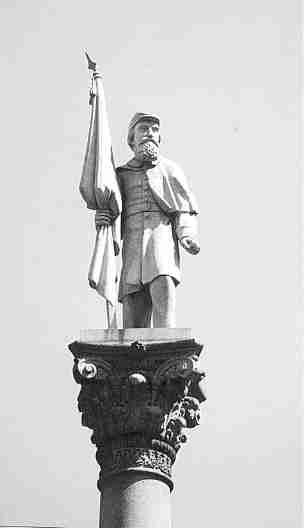
Memorial Day Started By Pioneer Woman Here
By H.A. LORBERG
Women of Portsmouth instituted Memorial Day, originally called DecorationDay back in the early '60s, and Amanda Pursell, wife of James Pursell, long a Front Street merchant, and splendid Christian gentleman, was the moving spirit in the patriotic work. As late as 1898, the metropolitan papers made reference to Mrs. Pursell's patriotism in war times. The papers only repeated what many of the older citizens long knew, but what many of the younger persons of that day - 30 or more years ago - never heard of. Mrs. Amanda Pursell, of Portsmouth, Ohio, who died at the age of 73, was the only woman who ever hired a substitute and sent him to the war, when there was no claim upon her whatsoever to do so. from another article(She paid $800 for his service but never wanted to know his name or his fate during the war. She never knew the identity of her mystery soldier.) Mr. Pursell, who was a wholesale dry goods dealer, died just previous to the rebellion, and the war coming on, Mrs. Pursell's children were too young to enlist. Her children where William M., Hal P., Charles and Maurice. As a Methodist, she was preeminently loyal to Bigelow Church, and her benefactions were without stint. Her home was always open to entertain ministers, the visiting presiding elders making it convenient to accept of her hospitality, and in fact all Christian workers found a temporary haven there at her old home, now 718 4th St.
In 1899, H.N. Johnson, of Lancaster, O., historian for the Grand Army of the Republic, put the following result of his researches into the records of the Ohio organization:
Origin of Memorial Day
Memorial Day has come to be a great occasion with the American people - not alone to the older ones does it bring tender memories, but a younger generation through it is learning to appreciate the patriotism and sacrifice of men otherwise revealed to them only in the pages of history. Now that another war is ended, which has added many to the graves to be decorated, a history of its origin may be interesting.
In 1861 Fort Sumter was fired upon, and immediately President Lincoln issued a call for 75,000 volunteers to aid the government and assist in the defense of Washington. Among the first to tender their services was a well-drilled, fully quipped company
of young men in Portsmouth, Ohio. The tender was accepted on April 17, 1861. Company G, 56th Ohio Volunteer Infantry was on the steamer Poland bound for Fort Donaldson via Paduca. Mrs. Amanda Pursell, a lady of means and influence in the city, realizing somewhat the privations and difficulties awaiting the boys, called together their mothhers the next week and said: "Your sons have gone to war and will soon need many things which the government is not prepared to furnish them. We must go to work and see what we can do." The result of these words was the organization of the Soldiers' Aid Society, with Mrs. Pursell as President, and work was begun at once. But a few days elapsed before several of these young soldiers were returned to their homes, maimed and liefeless as a result of their first battle and were honored with such a funeral as Portsmouth had never before witnessed. On the 30th of May following, the Ladies Aid Society, headed by its president, Bible in hand - those Mothers, 30 of them - bearing flowers and other tokens of affection, repaired to Greenlawn Cemetery, and there, with the green hills of Kentucky and the azure sky as witnesses, engaged in prayer and other memorial excercises over the graves of their loved and lost. As the years of the war passed on, their exercises were annually repeated. Nor when the war ended had they given up, but as late as 1900, those of the Society still living made their annual visits to the graves of those early victims of the rebellion and engaged in the same simple ceremonies. The Society also carried on in aid of the families of indigent soldiers and their orphaned children. The war over, neighboring towns began to pattern after the Portsmouth Mothers, and soon the practice became quite general, so much so that the G. A. R took the matter up and when Gen. John A. Logan was Commander-in -Chief, being a United States Senator, he secured the setting apart of May 30 as a National Memorial Day, and, as Commander, issued the proclamation calling upon the people generally to observe the day in suitable services for the soldier dead. The women, following the war, adopted the name of the Union Soldiers' Relief Circle, and secured the funds whereby the momument in Tracy Park was erected, the dedication took place on Decoration Day 1879, with Governor Mayes and other eminent men present. The following composed the Union Soldiers' Relief Circle, none of whom are now living, all having gone to their heavenly reward: Mrs. Amanda Pursell, Mrs. ohn N. Lodwick, Mrs. L. N. Robinson, Mrs. E. B. Grerue,Mrs. B. B. Gaylord, Mrs. Laura Watkins, Mrs. Charles Smith, Mrs. A. McFarland, Mrs. Henry Towne, Mrs. James Merrill, Mrs. John K. Lodwick, Mrs. T. J. Graham, Mrs. Samuel Reed, Mrs. Dan McFarland, Mrs. E. P. Pratt, Mrs. James Martin, Mrs. O. F. Moore, Mrs. Robert Lewis, Mrs. John Elden, Mrs. Eli Glover, Mrs. E. Burr, Mrs. Robert Bell, Mrs. George Johnson, Mrs. James Stephenson, Miss Emma Bell, Miss Mirian Firmstone and Miss Lizzie Glover.
John Barnes came to Portsmouth and was a clerk for William Elden, a Front Street dry goods merchant. He was a member of the First Presbyterian Church. He was killed at Vienna, Va., and was the first man from this city to give up his life for his country. Thus perished in his youth one of the noble-hearted of the young men of the country. He was of honorable ancestry, of pure morals, and led a sound and upright life. The statue on the top of the soldiers' monument Tracy Park represents Mr. Barnes.